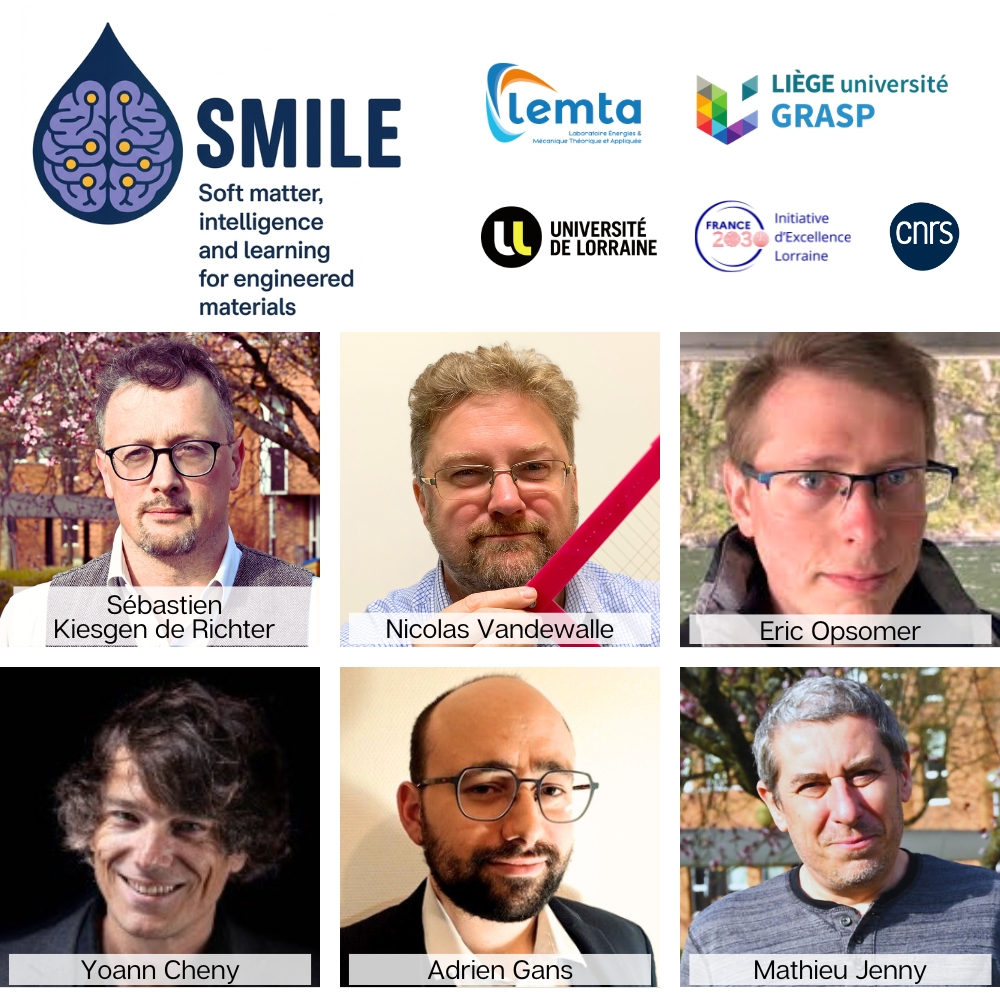
SMILE—Soft Matter, Intelligence, and Learning for Engineered Materials—is a new international research group funded by I-SITE Lorraine and jointly supported by the University of Lorraine and the University of Liège.
It builds on the long-standing scientific collaboration between its two founders:
– Sébastien Kiesgen de Richter, researcher in the Powder and Suspension Flows team at LEMTA, professor at the University of Lorraine, and member of the Institut Universitaire de France (IUF)
– Nicolas Vandewalle, director of the GRASP laboratory, professor at the University of Liège, and Francqui research professor (the Belgian equivalent of the IUF)
Soft matter refers to easily deformable materials such as gels, foams, pastes, suspensions, or granular media whose mechanical behavior is intermediate between that of a solid and a liquid, and which can change their rigidity or flow depending on the stresses and their environment.
The objective of SMILE is to develop a new generation of adaptive materials (soft robots, metamaterials, etc.) that can be characterized, optimized, and controlled using AI and hybrid approaches combining experiments, numerical simulations, and physical models.
SMILE brings together complementary expertise in:
- Soft matter and statistical physics
- Rheology of complex fluids
- Experiments, simulations, and modeling
- Artificial intelligence, deep learning, and physics-informed learning
The group is co-led by Nicolas Vandewalle and Sébastien Kiesgen de Richter, and brings together the expertise of researchers from Lemta: Adrien Gans (experiments), Mathieu Jenny (modeling), Yoann Cheny (deep learning), and Eric Opsomer from GRAPS (simulations).